
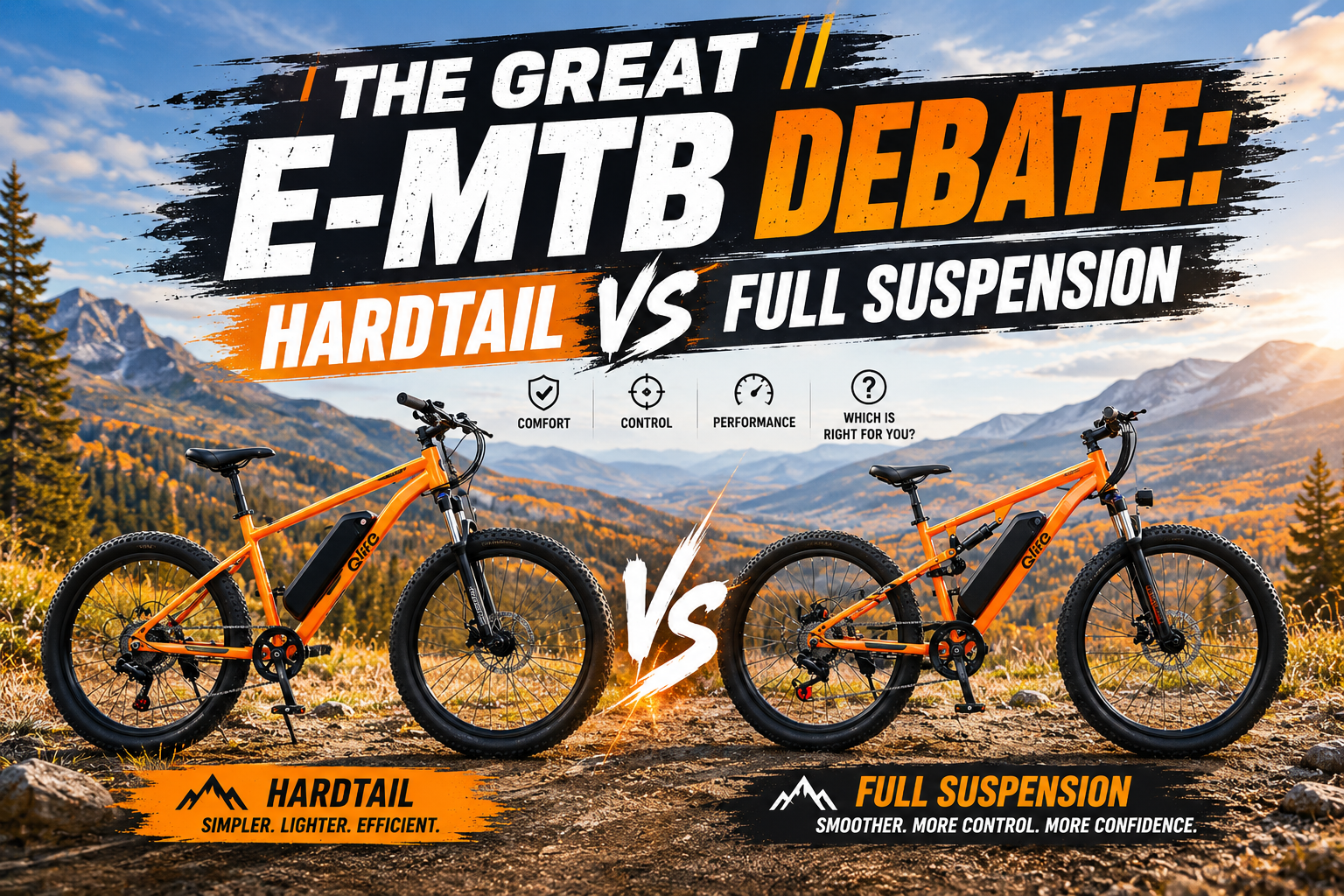
Electric mountain bikes (e-MTBs) are the choice of adventurers and off-roaders. The kind of rider who looks at a steep hillside with eager anticipation. But even for experienced riders, tackling tough trails comes down to the quality of your bike — in particular, the suspension.
Whether you’re riding rocky trails, wooded tracks, or just cruising around the city, choosing between hardtail and full suspension matters. But you’ve also got to factor in budget, bike weight, riding style, and bike usage.
Below, we dive straight into the great electric mountain bike debate, comparing hardtail and full suspension e-MTBs to find out which one is right for you.

Hardtail vs Full Suspension E-MTBS: Quick Answer
Hardtail e-MTBs are lighter, cheaper, and simpler to maintain. The suspension is exclusively on the front of the bike. It’s best suited to beginners, commuters/trail hybrids, and long-distance riders. The obvious downside is that if you tackle really difficult terrain, you may find the bike bounces more than intended.
Full suspension e-MTBs offer better comfort, traction, and control. Because the suspension is front and back, you have greater downhill confidence, letting you tackle the hardest routes other bikes struggle on. It’s best for technical trail riders and riders with back or joint discomfort.
|
Feature |
Hardtail E-MTB |
Full Suspension E-MTB |
|
Best For |
Smoother trails, commuting, XC riding |
Technical trails, rough terrain, descents |
|
Comfort |
Firmer, more direct ride |
Smoother and more forgiving |
|
Climbing |
Efficient and responsive |
Better traction on loose terrain |
|
Descending |
Capable but harsher |
More stable and confidence-inspiring |
|
Maintenance |
Lower cost and simpler |
Higher maintenance requirements |
|
Weight & Efficiency |
Usually lighter and slightly more efficient |
Heavier but more capable |
|
Price |
More affordable |
More expensive |
What Is a Hardtail e-MTB?
A hardtail electric mountain bike exclusively has a front suspension fork — the “hardtail” refers to the rigid rear end of the bike. You might wonder why a mountain bike would go without rear suspension. Well, suspension systems cost extra and add a lot of extra weight.
Removing the rear suspension means the bike goes faster, is more efficient, and isn’t as heavy to carry around. Great for XC riding, gravel-style riding, canal paths, forest trails, or mixed commuting and recreation.
Advantages of Hardtail e-MTBs
- Hardtails are usually much cheaper. They offer a lower entry point into e-MTB riding without sacrificing core performance.
- They’re simpler and easier to maintain. With fewer moving parts, servicing is cheaper, and setup is more straightforward.
- They feel efficient and responsive on smoother terrain. Hardtails transfer power well and often feel faster on fire roads, canal paths, and XC-style trails.
Disadvantages of Hardtail e-MTBs
- Hardtails can feel harsh on rough trails. Without rear suspension, rocks, roots, and trail chatter are far more noticeable.
- They provide less traction and control on technical terrain. Steep descents and loose climbs generally feel more stable on a full suspension bike.
What is a Full Suspension e-MTB?
Full suspension electric mountain bikes come with both a front suspension fork and a rear shock. The front suspension fork takes the impact as the bike first hits the ground downhill, while the rear absorbs the bumps and impacts of the trail. With less bounce, there’s more wheel traction and control on rougher ground.
These e-MTBs are increasingly popular in modern trail and enduro riding. They’re ideal for technical descending, giving riders a chance to push their skills to the limit.
Advantages of Full Suspension e-MTB
- Full suspension e-MTBs are far more comfortable on rough terrain. Rear suspension absorbs impacts from rocks, roots, and drops, making longer rides less physically demanding.
- They provide better grip and control. Improved traction helps keep the tires planted during technical climbs, corners, and descents.
- They inspire more confidence at speed. Full suspension bikes feel more stable and forgiving on steep or challenging trails, especially for newer riders.
Disadvantages of Full Suspension e-MTB
- Full suspension e-MTBs are significantly more expensive. Better suspension systems and more complex frames increase the overall cost.
- They require more maintenance and setup. Rear shocks, pivot bearings, and suspension tuning add extra servicing and adjustment requirements.
Which e-MTB Is Better for Beginners?
Generally, hardtails are the better option.
Hardtails are less complicated and more affordable to people who are first trying out e-MTBs. They’re unlikely to need the extra control and technical features as they’ll ride on easier trails.
That being said, full suspension e-MTBs can offer more confidence, comfort, and stability. If you’ve got joint or back aches, it can be a better entry model.
Best Option for Casual Riders
Most casual riders will never benefit from an expensive full suspension system. If your ride is usually on roads or light trails, the extra weight and suspension setup may not offer enough benefit to justify the tradeoffs.
Best Option for Technical Trail Riding
Expert or seasoned technical riders need every bit of stability and control they can get. If you’re riding on rough, steep, or rocky terrain, the best option is a full suspension e-MTB.
Climbing Performance: Which e-MTB Climbs Better?
Climbing performance relies on two factors: traction and power.
Maintaining traction is crucial when climbing steep terrain. And the speed at which you climb is determined by the power of the motor and the weight of the bike.
You can quickly see the advantages and disadvantages of both models. Hardtail e-MTBs are generally lighter, helping the motor climb more efficiently. However, the absence of a rear shock means that as the bike bounces, it loses traction.
So it really depends on the kind of hill you’re climbing. If it’s a smooth road or grassy trail, a hardtail e-MTB might have the advantage. But as the trail gets rougher, the full suspension e-MTB comes into its own.
Descending and Technical Trail Performance
Descending and technical trails have an obvious winner — full suspension e-MTBs. As mountain bikes descend, the back wheel is more likely to bounce, giving the rider less and less control. Full suspension e-MTBs counteract this effect, increasing stability, braking control, cornering grip, and confidence at speed over more difficult terrain.
Where Hardtails Still Perform Well
Hardtail e-MTBs still perform extremely well on flow trails, smoother singletrack, and XC-style terrain. Many riders enjoy their more direct, responsive trail feel, especially on faster rolling trails where efficiency and agility matter more than maximum suspension travel.
How to Choose the Right e-MTB for Your Riding Style
It really comes down to your budget and riding style. If you’re primarily a casual cyclist who enjoys a bit of trail riding on the weekend, investing in a full suspension e-MTB can be a big step up. You might want to prioritize other features like a bigger battery or a more powerful motor.
On the other hand, if there’s nothing you love more than speeding down a hillside, skidding around a forest trail, or pushing yourself up a mountainside, you are going to need all the help a full suspension system can give you.
Choose a Hardtail E-MTB If You…
- Ride smoother terrain
- Want lower maintenance
- Have a tighter budget
- Mix commuting with trails
- Prefer simplicity
Choose a Full Suspension E-MTB If You…
- Ride technical trails regularly
- Prioritize comfort and control
- Ride long distances
- Descend aggressively
- Want maximum traction and confidence
Qlife offers an electric mountain bike for everyone. The Racer Fat Tire 2.0 has a powerful 1,200W motor, up to 60 miles of range, and a 350lb payload capacity — it’s available in either front or full suspension.
For experienced riders, the Racer Ultra Step-Over Full Suspension Mountain eBike is the gold standard option. You take a slight hit on range, but that comes with the most advanced suspension system we offer.
Browse the full range of electric mountain bikes to find the one that’s right for you.
FAQs
Is a hardtail e-MTB better for beginners?
Generally, yes. Hardtail electric mountain bikes are lighter, cheaper, and simpler to use. While full suspension e-MTBs can give riders extra confidence on rough terrain, most beginners will start out on easier routes.
Are full suspension e-MTBs worth the extra money?
Yes — if you’re tackling tough, difficult terrain on a regular basis, it’s worth investing in a full suspension electric mountain bike. Otherwise, a hardtail is the better option.
Do hardtail e-MTBs have longer battery range?
They can. Hardtails are lighter, so the battery charge goes further. However, other factors like battery size, motor power, and overall bike weight will determine the final range of each model.
Which is better for commuting and trails: hardtail or full suspension?
Hardtails are generally more versatile, perfect for mixed-use riding. Full suspension e-MTBs are a specialist model, best reserved for challenging trail riding.
Can you ride technical trails on a hardtail e-MTB?
There’s no reason you can’t. However, hardtail e-MTBs have less stability and control, making the toughest routes more challenging to handle.
Share:
Is Full Suspension Worth It for City Riding?
Best E-Bikes Under $1,200 in 2026: Affordable Models That Are Actually Worth Buying